Point-to-Point Movement: How It Works
Open the box of Hannibal: Rome vs. Carthage and the first thing you notice is what’s missing. There are no hexagons and no squares, just a point-to-point map of the western Mediterranean where armies can only stand in places the designer chose to draw.
That is point-to-point movement, and it shaped some of the most influential strategic wargames of the last thirty years. A hex grid treats the world as a surface to be tiled. A point-to-point map treats it as a network of places and routes. In this post we’ll look at what the mechanic is, where it came from, how it differs from hexes and areas, which games made it famous, and what it does well — and badly.
What You’ll Find Here
What point-to-point movement actually is
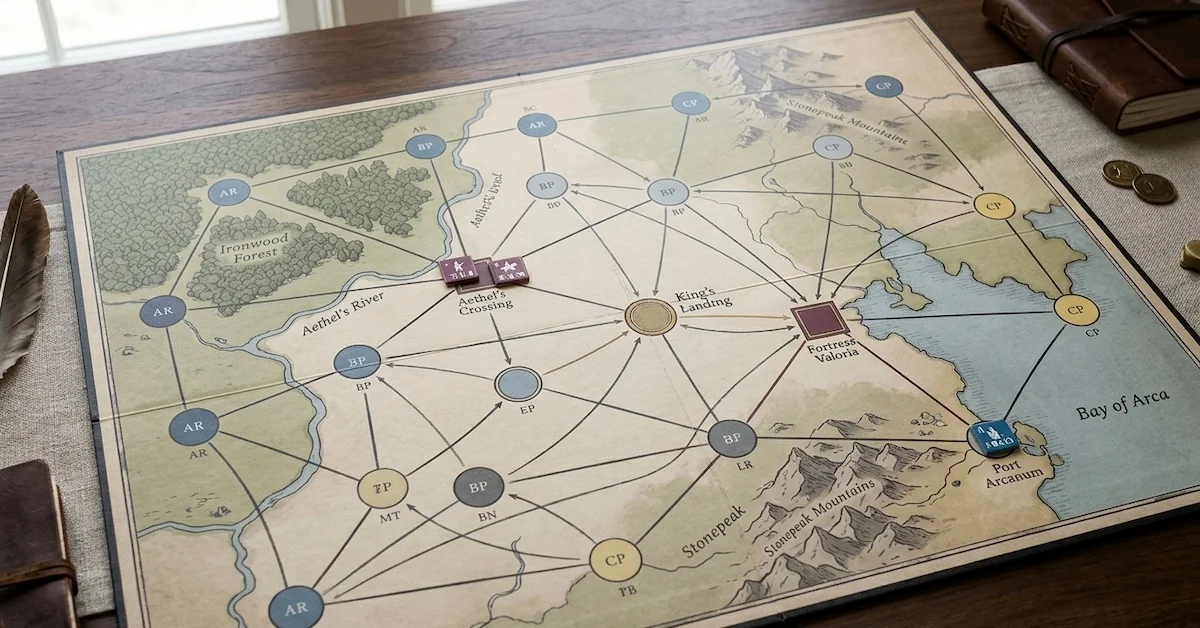
The map shows points connected by lines. Each point is a location — a city, a fortress, a pass, a port — that can hold units and carries its own terrain. Moving means travelling from one point to the next along a line, normally at one movement point per step: with a movement rate of three, a unit can advance three spaces. Rougher terrain can cost more.
The interesting design work lives in the lines. A line isn’t empty space; it carries rules. In Bayonets & Tomahawks the connections are highways, roads and paths, and each restricts which units may use it. In A House Divided the pathways are rivers, roads and railroads, with restrictions that depend on the mode of travel and the unit using it, and some connections cross a river, penalizing an attack made along them. Effects can even be asymmetric: in one introductory example, US Army units may keep moving through towns while Indian units must stop.
A short history: from rulers to grids to networks
Wargaming has always wrestled with one question: how do you let pieces move the way real troops move? When Georg Leopold von Reisswitz presented his Kriegsspiel to the Prussian king in 1812, blocks moved freely over a map, and dividers and rulers regulated distance. The alternative, a grid, had been criticized for forcing unrealistic maneuvers and unnatural terrain, with rivers running in straight lines.
Postwar board wargames needed something quicker than a ruler. Charles S. Roberts‘s Tactics (1954) is often credited as the first modern wargame, and square grids had a built-in flaw: the diagonal connections between squares are uneven. The fix was the hexagon. Piet Hein conceived a hex-based game in 1942, John Nash and RAND researchers explored hex boards for war games in the early 1950s, and in 1961 Roberts redesigned Gettysburg with hexes. Soon a high proportion of wargames used them.
Point-to-point arrived later and less dramatically. Pinning down a “first” game is hard, but some early examples are clear. Napoléon: The Waterloo Campaign, 1815 was first published in 1974 by Gamma Two Games of Vancouver, then licensed to Avalon Hill in 1977 and later reissued by Columbia Games. Frank Chadwick‘s A House Divided (GDW, 1981) covered the whole American Civil War with point-to-point movement, low-complexity rules and few counters.
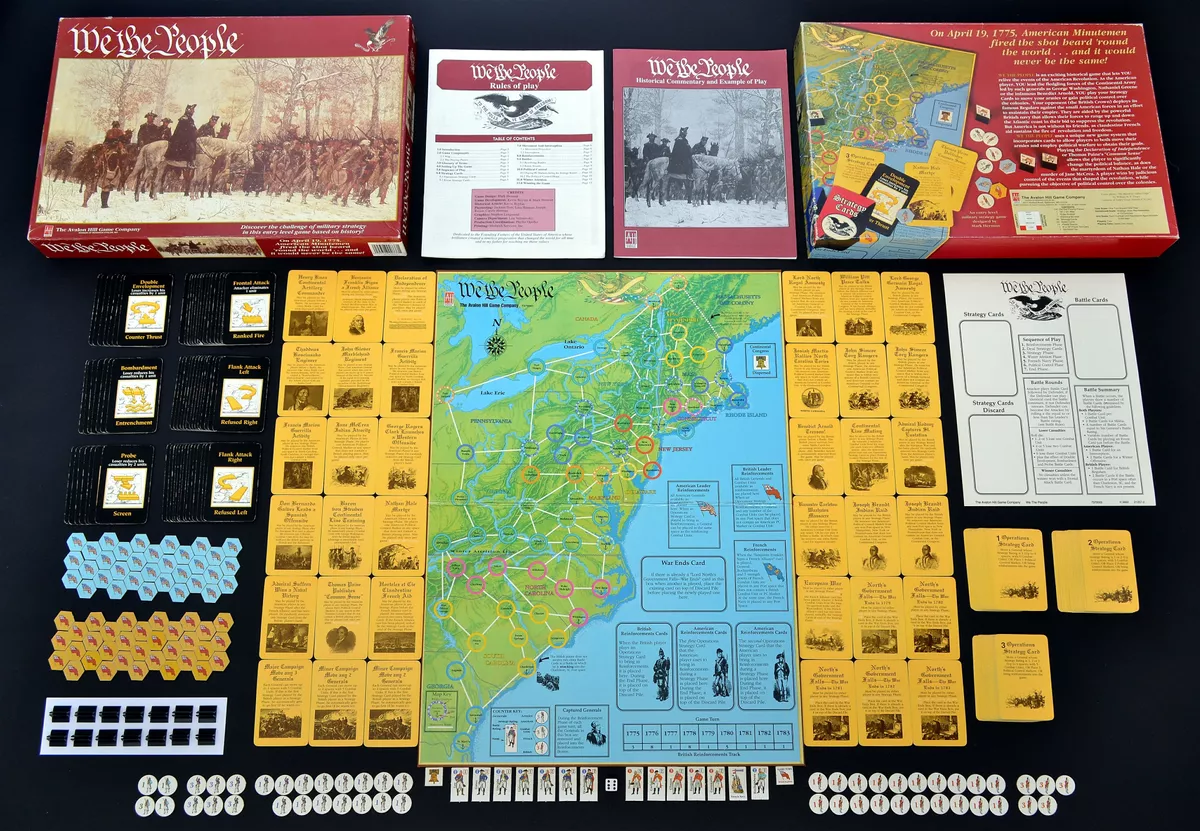
The breakthrough came in 1993 with Mark Herman‘s We the People (Avalon Hill). Herman scrapped a simplified remake of 1776 after reading the memoirs of British officer John Graves Simcoe, looking for a way to capture a war of skirmishes and raids. The new design paired a map of spaces joined by lines with a deck of cards. Herman later explained that he deliberately let the methodology become public domain, and many card-driven games copied its look and feel: point-to-point movement with named leaders activated by cards.
That is why the two ideas often travel together, but they aren’t the same thing. Napoléon and A House Divided predate cards, and card-driven design later moved beyond point-to-point maps — No Retreat! The Russian Front (2008) mixed cards with a classic hex-and-counter game.
Point-to-point versus the alternatives
Hexes: a hex map tiles the board into identical cells, and the distance between the centers of adjacent cells is always the same. That uniformity has a price: hexes have six directions of adjacency rather than eight, and designer Ezra Sidran argues they can produce absurd movement paths that no real unit would take. Point-to-point drops the uniformity and keeps only the routes that matter. Hexes are still the lingua franca of the hobby, though; point-to-point systems remain the exception.
Area Movement: it divides the map into regions of varying shape and size, and units move through adjacent regions. Often they are treated as relatives, but at the table they behave differently. In an area game, what matters is who holds the region and which borders it touches. In a point-to-point game the connection itself is the object: two places that are neighbors on a real map have no line between them if no road or pass joins them, and a line can carry restrictions of its own.
Free movement: kriegsspiel-style and miniatures games measure distance with rulers. That gives total flexibility at the price of arguments, arithmetic and a big table. Point-to-point gives up flexibility and makes every legal move countable at a glance.
The games that made it famous
Napoléon: The Waterloo campaign, played on a main map, with fighting moved to a smaller board when units come into contact.
A House Divided: The entire American Civil War, one month to the turn (two in winter), with each unit standing for 10,000 to 15,000 infantry on a map with no fixed ground scale. It won the Charles S. Roberts Award for best pre-20th-century boardgame of 1981.
We the People and For the People: The game generally credited as the first card-driven wargame, and its Civil War sequel, which plays four months to the turn at 6,000 men per strength point on a 22×34-inch map.
Hannibal: Rome vs. Carthage: Mark Simonitch’s Second Punic War comes with a 22×34-inch point-to-point map, 200 counters and 112 cards. Armies lose strength in unfriendly territory and political isolation bites. Interception counts against a campaign’s limited movement: an intercepted unit must count the interception space among its four movement points.
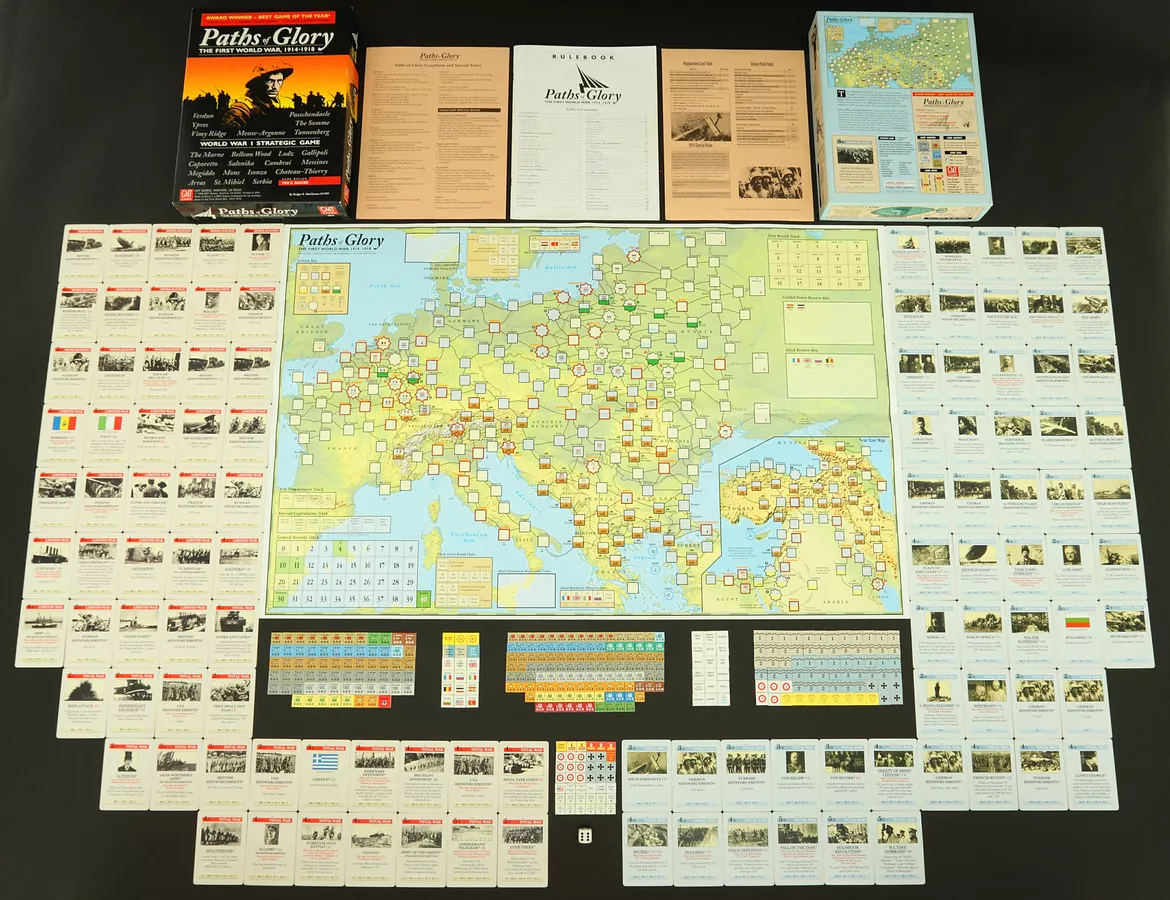
Paths of Glory: Ted Raicer’s system fits all of World War I on a single map. Every space costs one movement point, units out of supply can’t be activated and are eliminated if supply isn’t restored, and each card can be played for operations, strategic redeployment, replacements or an event. The same family later produced Barbarossa to Berlin for World War II and Crusade and Revolution for the Spanish Civil War.
Bayonets & Tomahawks: Marc Rodrigue’s first design, on the French and Indian War, gives every named point on the map a role as a place units can occupy, and ties movement to highways, roads and paths.
What it does well and where it struggles
Point-to-point maps are easy to read: instead of measuring or counting hexes, you count steps between names. They also free the designer from strict geography. A House Divided works without a fixed ground scale; the map only has to be right about what connects to what. And because the designer chooses which routes exist, the map is already an argument about how armies could move — which roads, passes and sea lanes mattered. Lines also make supply and isolation natural to model: out-of-supply units in Paths of Glory can’t act, and Hannibal punishes armies caught in unfriendly territory.
The costs are real. There is no open ground between points, so flanking and local maneuver have to be abstracted, and the mechanic suits the strategic and operational level better than the tactical. The map is also a fixed network: add or remove one line and you change the whole war. When you play a point-to-point game, you are playing the designer’s reading of the geography.
How to read a point-to-point map
Start with the lines, not the dots: what types exist, and who can use them? Look for chokepoints, the places with few connections, where one army can hold up another. Count your movement allowance against real distances, including the risk of interception. And trace every route back to a friendly base, because in many of these games supply decides campaigns before battle does.
To see how these principles work in practice, take a look at my review of Campaigns of Montrose, a wargame that brings the Scottish campaign of 1644–45 to life through a point-to-point map, where controlling routes and choosing when to engage the enemy are just as important as winning battles.
Final thoughts
Point-to-point movement isn’t a lesser hex. It’s a different claim about war: that what matters isn’t the ground between places but the places themselves, and the routes that join them. For campaigns decided by marches, sieges, passes and supply, that claim turns out to be a powerful one. Next time you open a wargame, check the map before the rules. It will tell you what the designer believes the war was about.