The Wars of the Three Kingdoms – An Overview
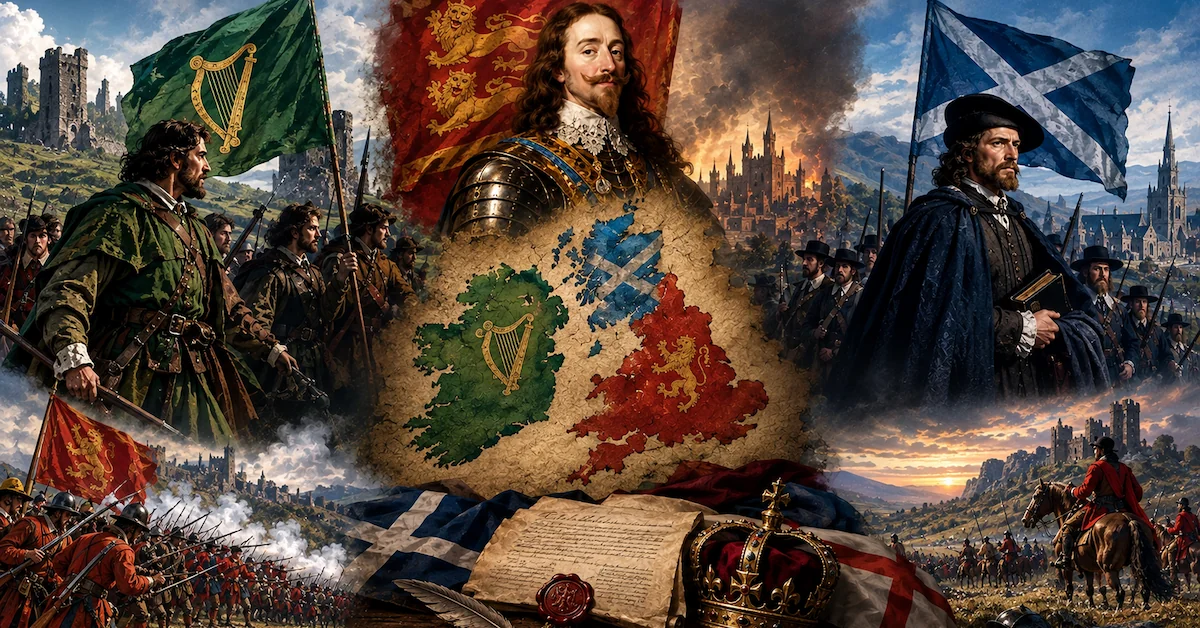
The Wars of the Three Kingdoms is the term historians use for the interconnected conflicts fought across England, Scotland, and Ireland between 1639 and 1651 — a period that includes the Bishops’ Wars, the English Civil War, the Irish Confederate Wars, and Scotland’s own civil war, including Montrose’s 1644-45 campaign. They’re usually treated as one connected crisis rather than several separate wars, because a decision made in one kingdom kept triggering a reaction in another.
What You’ll Find Here
Why “Three Kingdoms”?
Charles I ruled three separate kingdoms — England, Scotland, and Ireland — under a single crown, a personal union dating back to 1603, when James VI of Scotland became James I of England. But the three kingdoms were not politically or religiously unified: each had its own parliament, its own established church, and its own legal system. Charles’s repeated attempts to impose greater uniformity across all three — particularly in religious policy — are what set the whole crisis in motion.
The Bishops’ Wars (1639-1640): Where It Started
The trouble began in Scotland. Charles’s attempt to impose a new prayer book and a more episcopal church structure on the Presbyterian Church of Scotland provoked the National Covenant of 1638 and, soon after, open armed resistance. In the two brief Bishops’ Wars that followed, Covenanter forces effectively outmaneuvered the king, and the financial strain of the conflict forced Charles to recall the English Parliament — first the short-lived Short Parliament, then the Long Parliament — after eleven years of ruling without one. That recall, and the political crisis it triggered in England, is the direct link between a religious dispute in Scotland and the outbreak of civil war in England two years later.
The Irish Rebellion and Confederate Ireland
In 1641, a rebellion by Catholic Irish landowners against English and Scottish Protestant settlers erupted into wider conflict, giving rise to the Catholic Confederation of Ireland — often called Confederate Ireland. The rebellion deepened English political suspicion of Charles I, since rumors and accusations linked the king to the uprising, further poisoning his relationship with the English Parliament. It also had a direct military consequence for Scotland: Confederate Irish troops, including the force later led by Alasdair MacColla, would go on to fight in Montrose’s Scottish campaign.
The English Civil War (1642-1651)
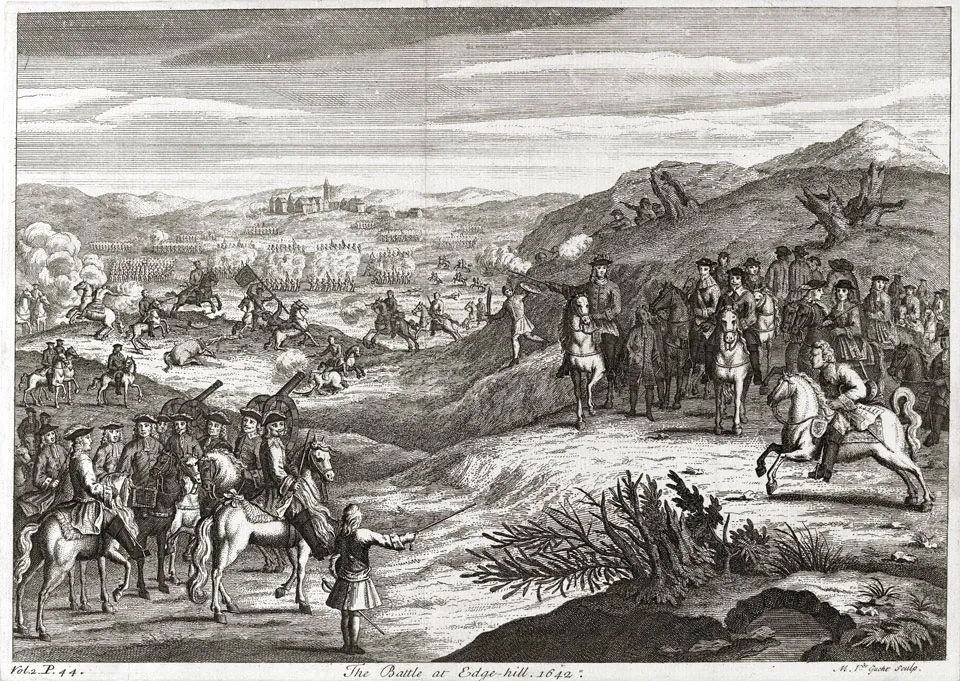
The best-known of the three conflicts, fought primarily between Charles I’s Royalists and the forces of the English Parliament, unfolded in several phases: the First Civil War (1642-1646), the Second Civil War (1648), the king’s trial and execution in January 1649, and a Third Civil War (1650-1651) fought in the name of the exiled Charles II against the new English Commonwealth.
The Solemn League and Covenant (1643)
In 1643, the Scottish Covenanters and the English Parliament signed the Solemn League and Covenant, an alliance in which Scotland committed military support against the king in exchange for a promise to establish Presbyterianism in England as well. This agreement is the direct trigger for Montrose’s break with his former allies: he read it not as a defense of Scottish liberties but as a subordination of loyalty to the crown, and switched to the Royalist side in 1643 largely in opposition to it.
Scotland’s Own Civil War: Montrose’s Campaign (1644-45)
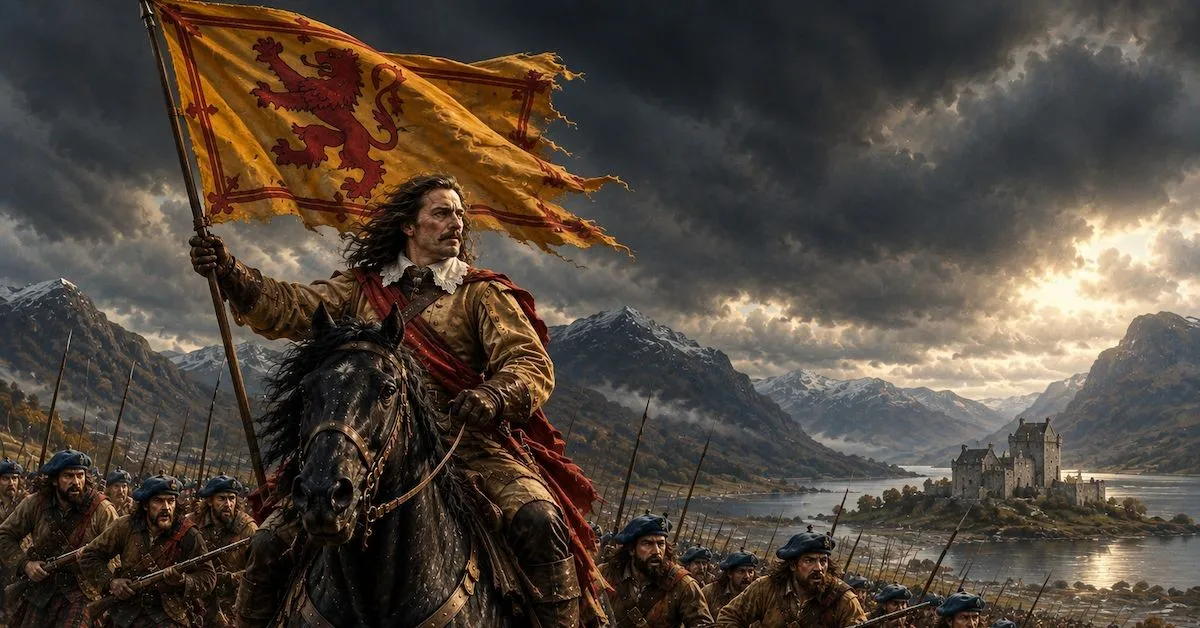
Montrose’s campaign was, in effect, Scotland’s own civil war within the larger conflict — a Royalist countermovement fought inside a kingdom the Covenanters otherwise controlled almost entirely. Its strategic purpose for Charles I was straightforward: a Scottish uprising in his name might force the Covenanters to withdraw troops committed to the English theater, easing pressure on his forces there.
Full coverage of the campaign itself: Montrose’s Campaign, 1644-45: The Complete Guide
How It All Ended
Charles I’s execution in January 1649 didn’t end the wars. Oliver Cromwell led a brutal conquest of Ireland between 1649 and 1653, followed by an invasion of Scotland in 1650-51 after the Scots proclaimed the exiled Charles II king. The wars finally concluded with the Royalist defeat at the Battle of Worcester in September 1651, which sent Charles II into continental exile until the Restoration of the monarchy in 1660.
Why the Interconnection Matters
Treating these conflicts as one interlinked crisis, rather than a single English civil war with a few side conflicts, changes how the whole period reads. A prayer book dispute in Edinburgh helped trigger a parliamentary crisis in London. A rebellion in Ireland deepened the distrust that made civil war in England harder to avoid. An alliance between Scottish Covenanters and the English Parliament directly produced the Royalist rebellion that Montrose spent a year fighting. None of these events happened in isolation — which is exactly why “Wars of the Three Kingdoms” has become the term historians reach for instead.