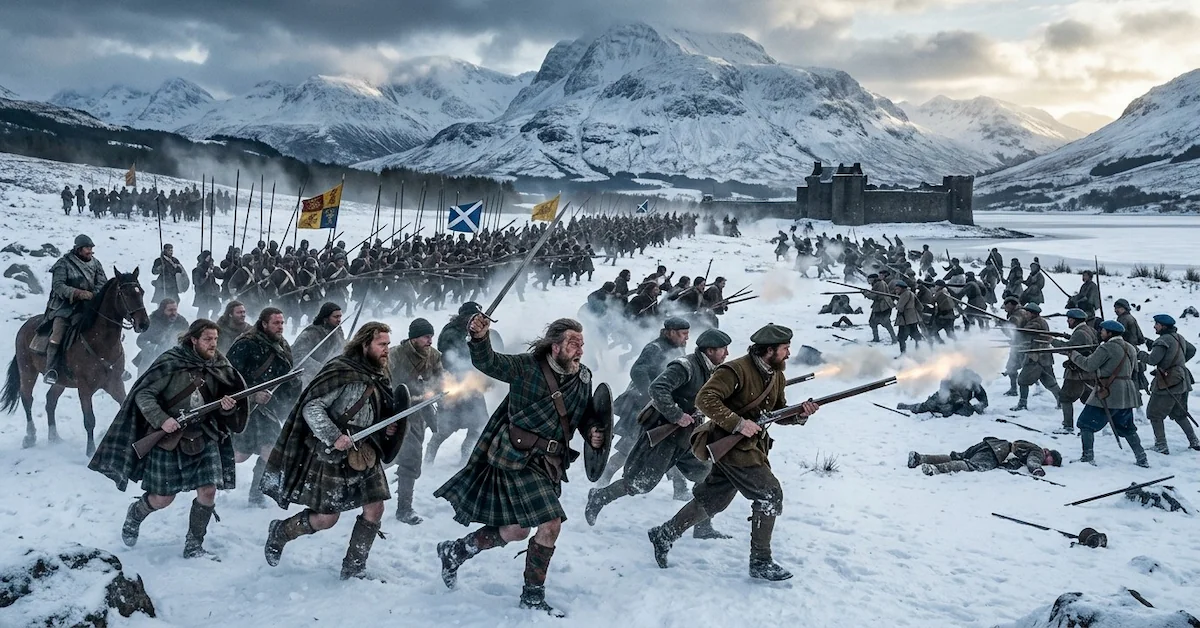
The Battle of Inverlochy (1645): Montrose’s Winter Victory
The Battle of Inverlochy was fought on 2 February 1645 (Candlemas Day) on the plain beside Old Inverlochy Castle, at the foot of Ben Nevis, near modern Fort William. A Royalist army under James Graham, Marquess of Montrose, destroyed a Covenanter army that Sir Duncan Campbell of Auchinbreck commanded on behalf of Archibald Campbell, Marquess of Argyll. Montrose won it with a forced march of roughly 30 to 36 miles in about 36 hours through the winter hills of Lochaber, which brought his men down on an enemy who expected him to be far away.
What You’ll Find Here
Background: A Winter Campaign in Argyll’s Country
By the winter of 1644-45 Montrose had won at Tippermuir and Aberdeen and had been joined by clansmen from the west. He left Blair Atholl on 11 December and marched into Argyll’s own country as far as Inveraray. He could not take the castle there, and Argyll escaped by sailing down Loch Fyne. From there Montrose marched north through Glencoe and Lochaber, passing Inverlochy on the way. At the end of January he halted at Kilcumin, modern Fort Augustus. Many clansmen had gone home with their plunder by then.
His position was dangerous. Argyll was following behind him, and a second Covenanter force under the Earl of Seaforth, mostly Mackenzies and Frasers, was approaching from the north. Montrose could have turned back down the Great Glen, but he rejected that option and took a circuitous route over the hills instead.
The Forces at Inverlochy
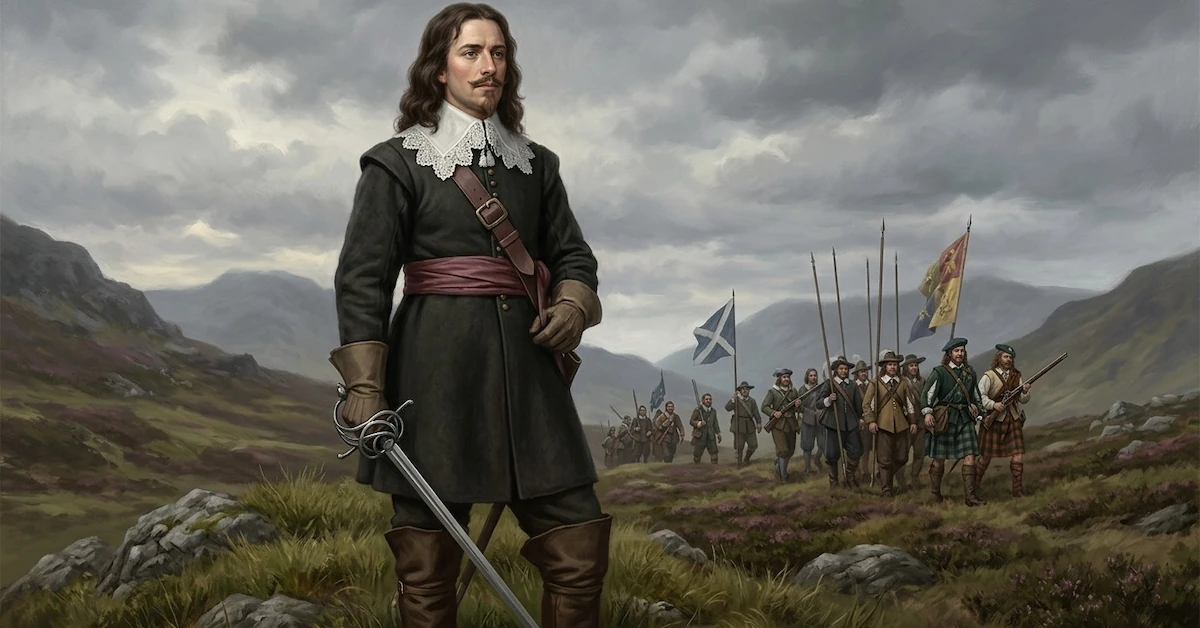
The Royalists. The sources report 1,500 men at the start of the march and about 2,000 when the army reached Kilcumin. The core was highland clansmen and the Irish Confederate troops under Alasdair MacColla.
The Covenanters. Sources list Argyll’s own regiment (500), Clan Campbell levies (about 1,000) and two Lowland battalions of about 200 men each, roughly 1,900 in all. Other authors give about 3,000, including some 1,100 Lowland regulars supplied by General Baillie. Sir Duncan Campbell of Auchinbreck held the field command, as Argyll had recalled him from Ireland to lead the army.
The March: Over the Hills of Lochaber
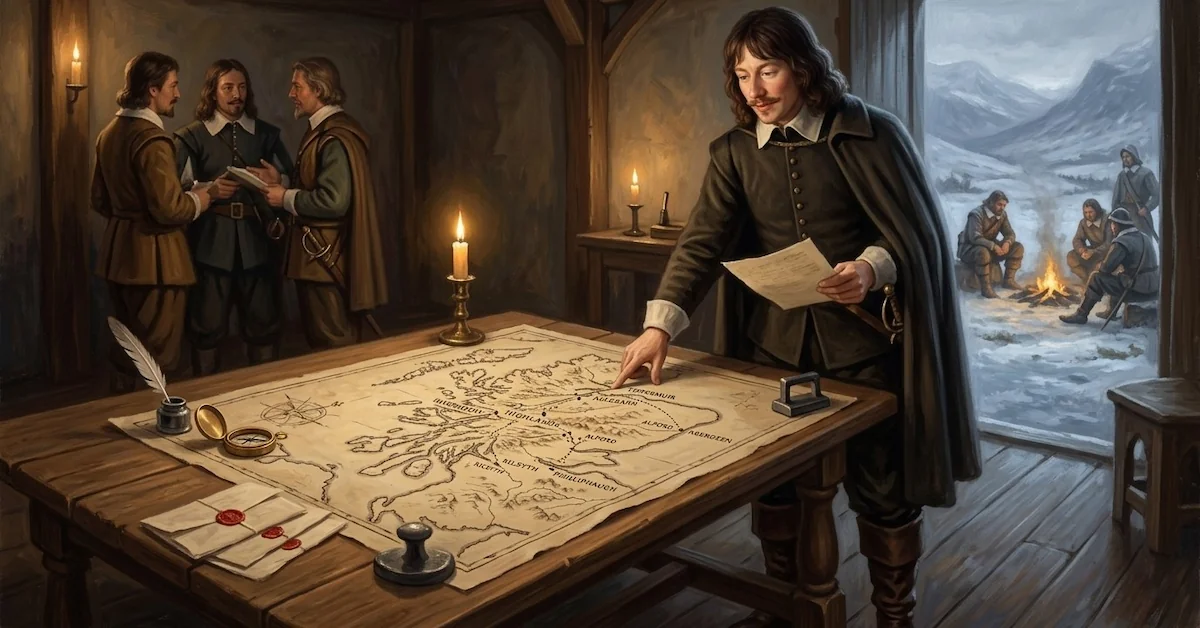
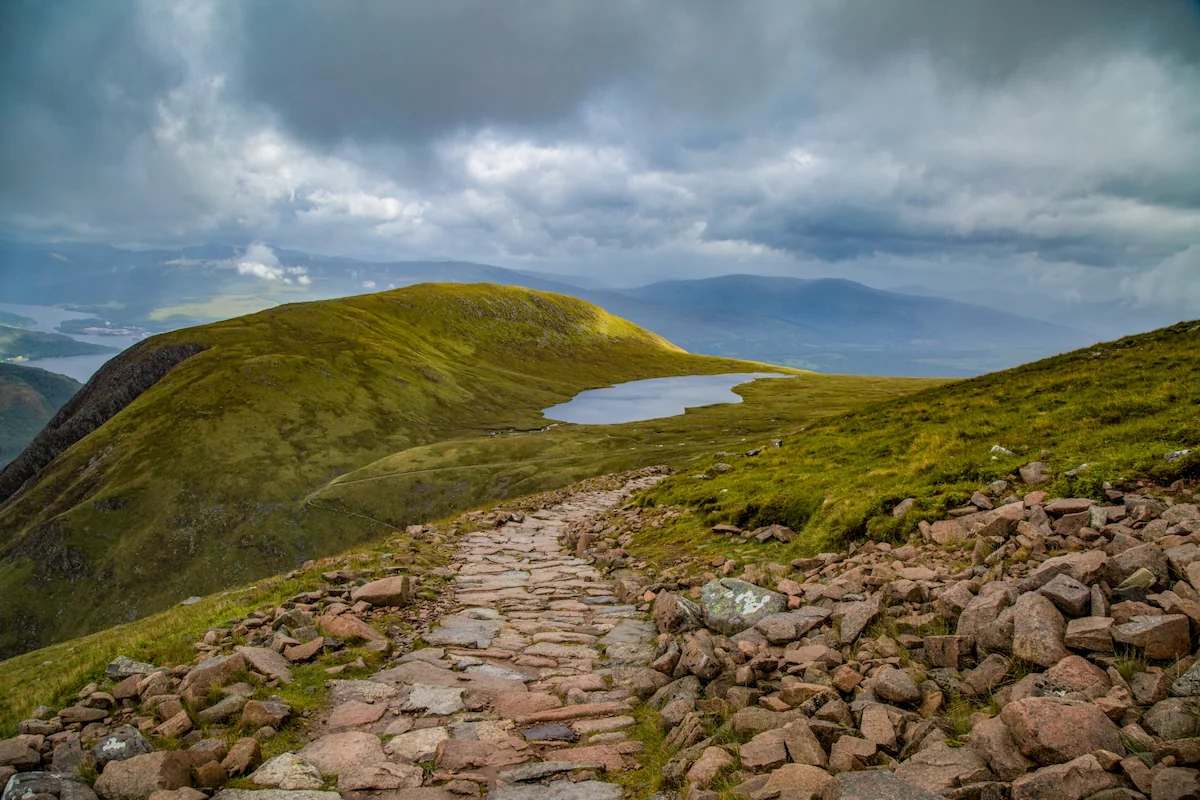
The route ran up Glen Tarff and past Culachy, over the gorge of the Calder Burn and the high col of Carn na Larach, then down Glen Turret and Glen Roy to Keppoch. The army forded the River Spean, near Corriechoille, and came out at Torlundy on the slopes of Ben Nevis above Inverlochy. The men marched through snow without fires. Although sources differ on the exact distance, most accounts suggest that Montrose’s army covered around 30 miles in approximately 36 hours. The strategic surprise was real: the Covenanters expected Montrose to be thirty miles away, and the army arrived in front of an enemy who believed him to be elsewhere.
The Dawn Battle
Deployment. The Covenanters stood on a ridge of firm ground south of the River Lochy, with their left anchored on Old Inverlochy Castle. The castle held about 50 musketeers, and the wing was reinforced with 200. Argyll’s regiment in the centre, the Lowland battalions on the flanks and the Campbell levies in reserve under the lairds of Lochnell and Rarra, with two light guns.
The Royalists were in two lines, with the clansmen in the centre under Montrose himself, and the Irish on the flanks: MacColla on the left and O’Cahan on the right. Sir Thomas Ogilvie of Airlie led light cavalry guarding the standard.
The fighting. At first light, MacColla led the two Irish flanks forward on Montrose’s orders. They fired their muskets at close range and then went in with swords and dirks. The Campbells fired their muskets once before the charge came in, sword in hand, with a great shout. The flanks broke within minutes and the centre followed. Montrose then advanced his own centre to complete the rout.
Argyll on the Loch
Argyll did not stay with his army. He had injured his arm in a fall from his horse and withdrew to his galley on Loch Linnhe, leaving Auchinbreck in command, and watched the slaughter from his barge on the lake to which he had retired.
On 11 February Parliament found Montrose and 19 followers, MacColla among them, guilty of treason in their absence. Argyll appeared before Parliament the following day with his arm in a sling and called the defeat a minor setback. Lord Balmerino claimed on his honor that no more than thirty of Argyll’s men had been killed.
Casualties and Aftermath
Covenanter losses. The defeat was devastating for Argyll’s army. Approximately 1,500 Covenanters were killed, making this the most widely accepted estimate, although some accounts place the figure as high as 1,700 or even 1,800. Much of the slaughter took place during the pursuit of the fleeing troops, as Montrose’s Highlanders and Irish soldiers chased the remnants of the Campbell army for several miles towards the Lairig Mhor. Among those killed were John Campbell of Lochnell and Colin MacDougal of Rarra, while the surviving officers were taken prisoner.
Royalist losses. Montrose’s casualties were remarkably light by comparison. The most commonly cited figure is four men killed, although contemporary accounts give figures ranging from three to eight. These numbers should be treated with some caution, as Royalist reports may have understated their losses. The Royalists also suffered a number of wounded, while Sir Thomas Ogilvie, struck by a stray bullet during the fighting, died several days later.
The contrast between the two armies’ losses was extraordinary: around 1,500 Covenanters killed against just four Royalists. Whatever the precise figures, Inverlochy was not merely a decisive victory for Montrose, but a catastrophic defeat for the Campbell forces.
The poem. Iain Lom witnessed the battle, and according to the sources, he climbed a tree to see his chief and his clansmen at work, despite his limp. He composed the poem Là Inbhir Lochaidh (“The Day of Inverlochy”), which the same entry calls “an important historical source regarding the battle”.
The wider effect. The victory secured the cooperation of the Marquess of Huntly and his Clan Gordon levies. After resting at Inverlochy, Montrose recrossed the Lochaber mountains into Badenoch.
Why the Battle of Inverlochy Mattered
The victory at Inverlochy dealt a devastating blow to Argyll’s forces, and Montrose had defeated his rival in the very heart of Campbell territory. It also helped secure the support of Huntly and his Gordon levies, strengthening the Royalist cause in Scotland. More importantly, Inverlochy demonstrated what made Montrose’s campaign so remarkable: his willingness to attempt marches that conventional armies would have considered impossible, and his ability to turn such risks into decisive victories. This would become a recurring feature of the campaign throughout 1645, as Montrose continued to achieve victories against seemingly overwhelming odds.
To follow the campaign from beginning to end, see Montrose’s Campaign, 1644-45: The Complete Guide. And if you want to see how this extraordinary march is recreated on the tabletop, take a look at my review of Campaigns of Montrose.