The Battles of Montrose’s Campaign
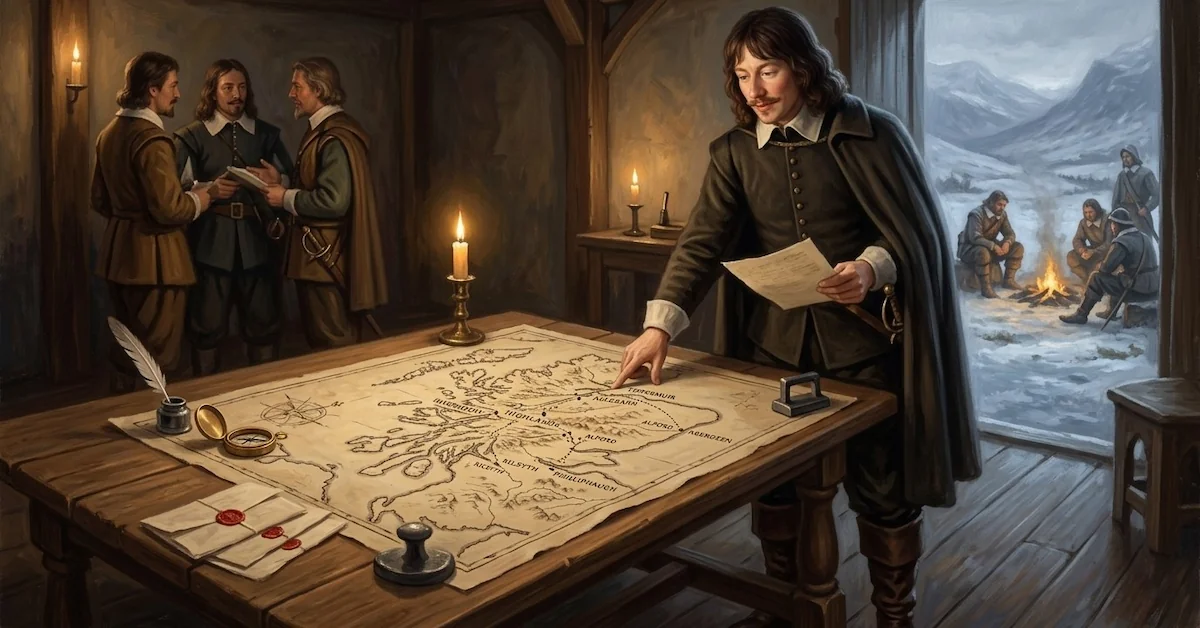
Between September 1644 and September 1645, James Graham, Marquess of Montrose, led a remarkable Royalist campaign in Scotland during the Wars of the Three Kingdoms. In just over a year, he fought seven major battles, winning six against Covenanter forces before his army was defeated at Philiphaugh. From Tippermuir and Inverlochy to Auldearn and Kilsyth, the Seven Battles of Montrose’s Campaign reveal both his tactical skill and the fragility of the Royalist cause in Scotland.
What You’ll Find Here
Tippermuir — 1 September 1644
Montrose’s first battle came almost immediately after he linked up with Alasdair MacColla’s Irish Confederate troops near Blair Atholl. Lord Elcho’s Covenanter militia, roughly twice the size of Montrose’s scratch force, blocked the road to Perth. Many of Montrose’s highlanders had no muskets at all; some reportedly went into battle armed with stones.
Montrose stretched his outnumbered line thin to avoid being outflanked, then did something unexpected for the era: instead of the usual prolonged exchange of musket fire, he ordered a single volley followed immediately by a full charge. The shock broke Elcho’s line before it had time to reload. Perth surrendered without a fight the same day.
Aberdeen — 13 September 1644
Twelve days later, Montrose faced a second Covenanter force outside Aberdeen. Before the battle, a young drummer boy sent forward under a flag of truce to deliver terms was shot dead by Covenanter troops — a violation of the conventions of war that enraged Montrose’s men. Montrose won the battle on open ground north of the city.
What followed was uglier than the battle itself. Aberdeen, a town that had largely tried to stay out of the conflict, was sacked for several days afterward — one of the darker episodes of the campaign, and a reminder that Montrose’s victories didn’t always translate into mercy for the civilians caught in their path.
Inverlochy — 2 February 1645
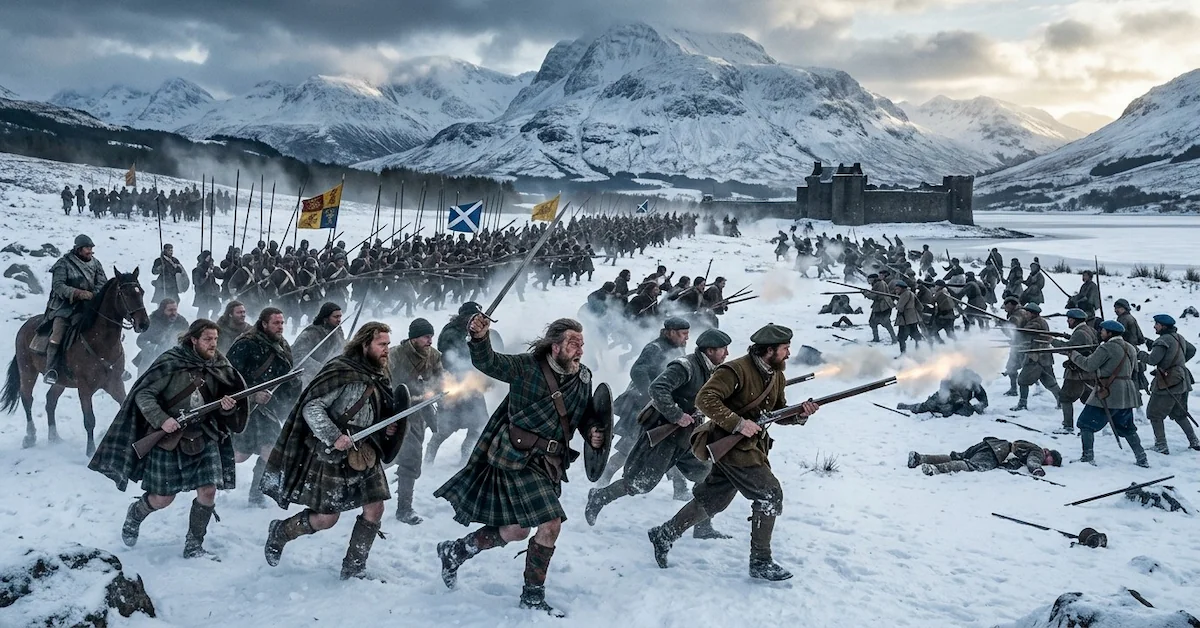
By winter, Montrose needed to deal with Archibald Campbell, Marquess of Argyll, the most powerful noble in Scotland and his personal nemesis. Rather than approach by the expected route, Montrose marched his army some 36 miles across the snow-bound flanks of Ben Nevis in roughly 36 hours — terrain Argyll’s forces considered impassable in winter, and therefore didn’t bother to watch.
The result was one of the most complete surprises of the entire war. Argyll, sidelined by an injured shoulder, watched the destruction of his own clan’s army from a boat on the loch.
Full account of the march and the battle: The Battle of Inverlochy: Montrose’s Winter March
Auldearn — 9 May 1645
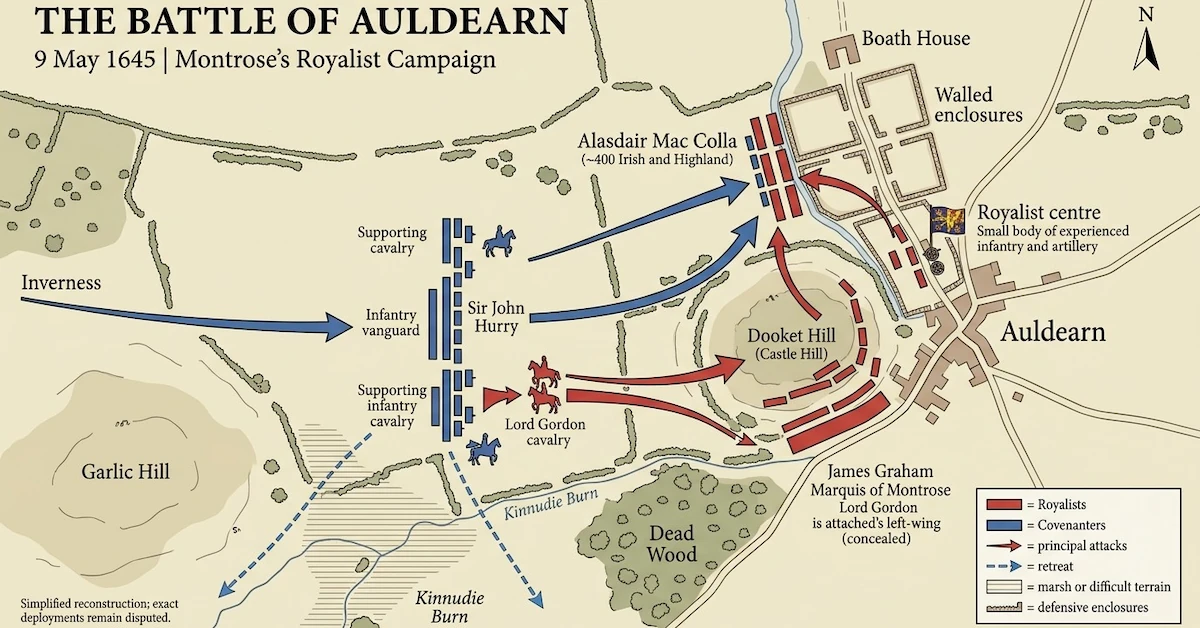
Facing a larger Covenanter army under Sir John Hurry near Nairn, Montrose used deception rather than brute force. MacColla’s troops, flying Montrose’s own banner, were placed prominently on one flank as bait, drawing Hurry’s attack while the bulk of the Royalist army stayed concealed behind rising ground. Once Hurry committed, Montrose’s hidden force swung in and enveloped him. Accounts suggest the battle could easily have gone the other way, but it worked.
Alford — 2 July 1645
Against William Baillie’s Covenanter army, Montrose again used terrain to hide his true strength until the last possible moment, luring Baillie into a disadvantageous position before his cavalry broke through. The victory came at a personal cost: Lord Gordon, one of Montrose’s most valuable cavalry commanders, was killed in the moment of triumph.
Kilsyth — 15 August 1645
Montrose’s greatest victory, fought in brutal summer heat — heat severe enough that, by some accounts, highlanders stripped off their plaids before charging. Baillie’s army, hampered by conflicting orders from the Covenanter government’s own political committee looking over his shoulder, was destroyed. For the first and only time in the entire British civil wars, Scotland was effectively under Royalist control.
Philiphaugh — 13 September 1645
A month after Kilsyth, Montrose’s army was a shadow of the force that had won it. Highlanders had gone home with their plunder, as they always did after a battle, win or lose — only this time there was no next battle to bring them back before disaster struck. Near Selkirk, what remained of his forces was caught in fog by David Leslie’s professional cavalry, recently recalled from England. The battle was over in about an hour. Montrose escaped; his army, and with it Royalist Scotland, did not.
What the Timeline Doesn’t Show
A list of battles makes the campaign look like a clean upward line broken by a single crash at the end. It wasn’t quite that simple — the army that won at Tippermuir was never the same army twice, reshaped constantly by desertions, reinforcements, and the shifting loyalties of the clans involved. That instability is exactly what made the string of victories so improbable, and exactly what made the collapse, when it came, so fast.
Montrose’s Campaign on the Tabletop
Six victories in seven battles make Montrose’s campaign one of the most remarkable episodes of the Wars of the Three Kingdoms — but how well can a wargame capture the tactical brilliance and strategic fragility behind those results?
In my review of Campaigns of Montrose, I explore how the game recreates Montrose’s 1644–45 campaign and the challenges of leading his outnumbered Royalist forces.